Shopify guide · 6 min read
Etsy vs Shopify vs your own site for wall art sellers
Short answer: Etsy offers access to existing marketplace search, without promising traffic or orders. You pay per listing and per sale (USD 0.20 a listing, 6.5% of each sale, plus card processing). Shopify, or your own site, is better once you can bring your own traffic from Pinterest, Instagram, email or ads: you pay a monthly plan and card fees, and you own the brand. A common path is to start on Etsy and add a store later, with the same print-on-demand provider and photos.
The platform decides who finds your art and what each sale costs. This guide compares them for print-on-demand framed canvas, framed prints and posters, with Etsy's and Shopify's own numbers. Whichever you choose, the Etsy mockup generator makes room photos that work on both.
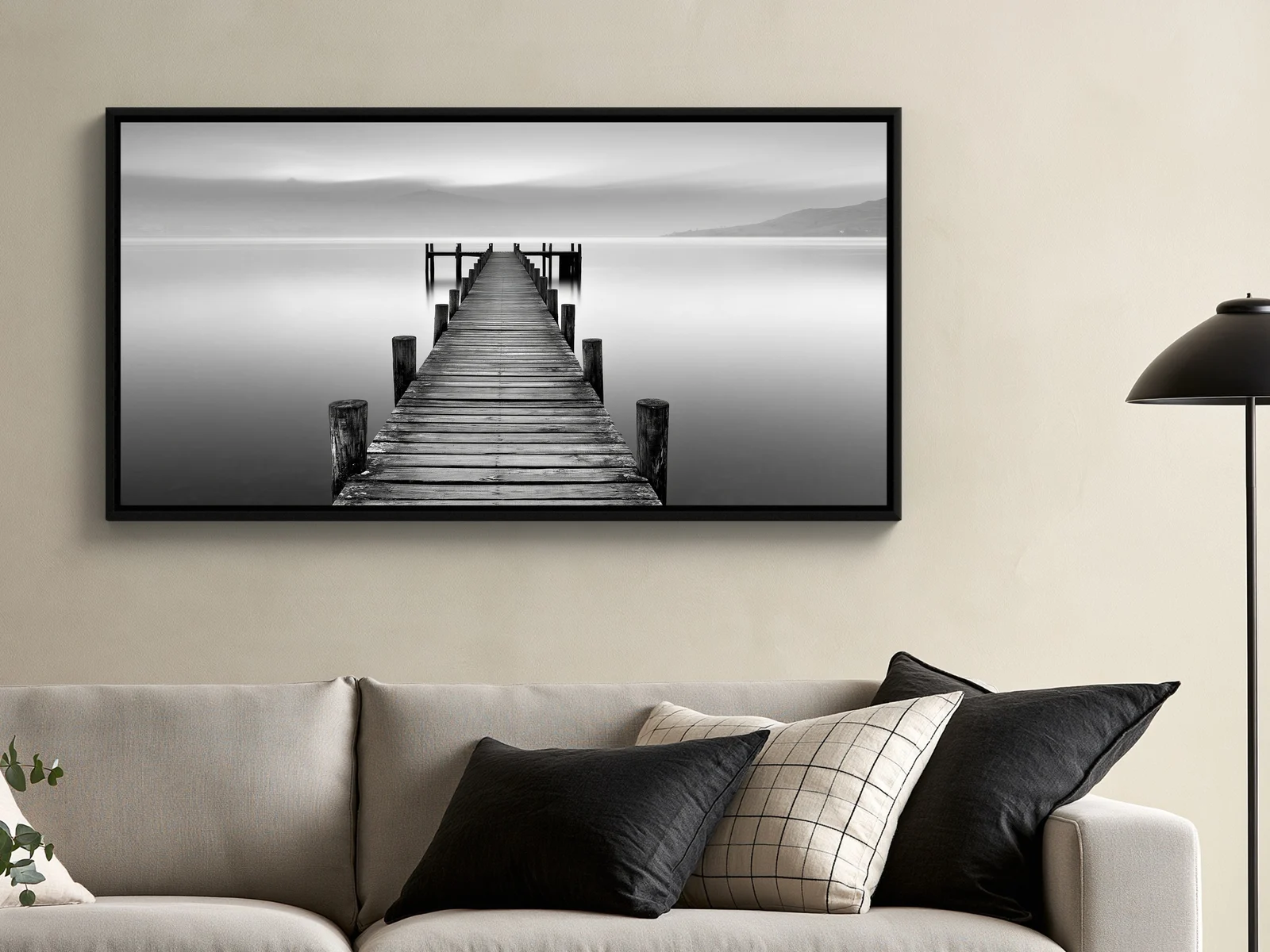
The short comparison
| Etsy | Shopify | Your own site (other builders) | |
|---|---|---|---|
| Who brings buyers | Etsy search and its marketplace | You | You |
| Main costs | USD 0.20 per listing, 6.5% transaction fee, card processing (US: 3% + USD 0.25) | Monthly plan, card processing; an extra 2% on Basic if you use a third-party payment provider | Builder plan, card processing |
| Product options | Up to 3 variation types; photos linked to up to 20 options | Up to 3 options and 2,048 variants; one image per variant | Depends on the builder |
| Photos | Up to 20 photos and 2 videos per listing | Up to 250 media items per product | Depends on the builder |
| Brand and customer | Etsy's page, Etsy's rules | Your domain, your design, your email list | The same |
| Print-on-demand | The main providers connect to both Etsy and Shopify; see how to choose a provider | ||
Checked 2026-10-29. Sources: Etsy fees, Etsy processing fees, Etsy variations, Etsy listings, Shopify pricing, Shopify variants.
Etsy: buyers first, fees per sale
Etsy's strength for wall art is search. Shoppers type "framed canvas wall art" or "japandi print" and your listing can appear on day one. In return you pay on every sale (checked 2026-10-29):
- USD 0.20 per listing, which lasts 4 months.
- 6.5% of the item price plus the shipping you charge.
- Card processing, which varies by country: 3% + USD 0.25 in the US.
- Offsite Ads on orders that came from Etsy's ads elsewhere: 15%, or 12% for shops with USD 10,000 or more in sales over the past 365 days, never more than USD 100 per order.
On a USD 129 framed canvas with shipping included, the US fees come to USD 12.71, about 10% of the price. Our guide to pricing wall art on Etsy works it through for every size.
If you bring your own traffic to Etsy, Share & Save refunds 4% of the eligible order total when a buyer orders within 30 days of clicking a link you shared (Etsy).
Shopify and your own site: your traffic, your brand
A Shopify store is your own shop on your own domain. Nobody is browsing it until you send them. In return:
- Separate fixed and variable costs. You pay a monthly plan plus card processing. Shopify's pricing page lists an extra 2% on Basic when you use a third-party payment provider instead of Shopify Payments (1% on Grow, 0.6% on Advanced). Plan prices depend on your country and on monthly or yearly billing, so check Shopify's pricing page.
- No per-listing fee and no marketplace cut. Above a certain monthly volume this costs less than Etsy's percentages; below it, the plan fee dominates.
- Your brand, your buyers. Your design, your domain, your email list and your rules, with no other sellers' art on the same page.
You also take on the work Etsy did for you: the shop's design, its policies pages, answering buyers, and getting found by search engines and on social media. For a wall art shop, Pinterest is a natural first traffic source, because people use it to save ideas for their rooms; see wall art mockups for Pinterest and Instagram.
Other website builders work the same way: a monthly plan, card fees and your own traffic. Choose by whether your print-on-demand provider connects to it.
A simple break-even test
Compare one month's costs, using your own numbers:
- Etsy: your monthly sales × about 9.5% (transaction + processing), plus USD 0.45 per order and any Offsite Ads fees.
- Shopify: your plan's monthly price plus your card processing on the same sales.
Example: 20 orders at USD 129 is USD 2,580 in sales. Etsy's fees are about 20 × 12.71 = USD 254 a month before Offsite Ads. If your Shopify plan and card fees for the same sales come to less, Shopify is cheaper, but only if those 20 orders still happen without Etsy's search. This simplified US example excludes taxes, ads, refunds and customer acquisition costs. Those 20 orders are an assumption, not observed migration results: can you bring those buyers yourself?
What changes for wall art listings
- Options. Both handle size and frame colour. Etsy links photos to up to 20 options of a variation; Shopify gives each variant one image from the product's media. See Etsy variations for wall art and Shopify wall art product images.
- First image shape. Etsy wants a landscape or square first photo (Etsy); Shopify suggests a consistent aspect ratio across main images (Shopify). Square room photos suit both.
- Print-on-demand sync. On both, a provider's republish can replace your own photos. Keep your image files and check each variant after a sync.
- Disclosure. Etsy requires sellers who use a production partner to disclose it on the listing (Etsy). On your own site, say who makes and ships the piece in your policies.
Running both, with one set of photos
A common set-up is to keep Etsy for search and add a Shopify store for repeat buyers, Pinterest and Instagram traffic. With print-on-demand there is no stock to split: the same provider can fulfil both. What you need twice is the listing work, so make the photos once and reuse them.
WallMock makes the room photos; today you download the images and upload them to each. Send to Shopify is in beta; for Etsy, you upload the Etsy-ready downloads in the listing editor. Send to Shopify is on Pro (1 store, up to 10 products a month) and the WallMock Studio plan (up to 3 stores) during the beta and will be on every plan when it opens (up to 10 products a month on Free, Lite and Pro, unlimited on the Studio plan; see the plan split). Save favourite rooms once, add a whole collection, and every artwork comes out in every chosen room, with downloads at 4,096 px on the long edge on Free and paid plans. Check the final platform crop.
Etsy is a trademark of Etsy, Inc. WallMock is an independent service and is not affiliated with or endorsed by Etsy.
Read next: pricing wall art on Etsy, Shopify wall art product images and how to sell wall art on Etsy.
Sources
- Etsy Help: What are the fees and taxes for selling on Etsy?, checked 2026-10-29
- Etsy Help: Payment processing fees, checked 2026-10-29
- Etsy Help: Save on fees with Share & Save, checked 2026-10-29
- Etsy Help: How to add variations to your listings, checked 2026-10-29
- Etsy Help: How to create a listing, checked 2026-10-29
- Shopify: Pricing (third-party transaction fees), checked 2026-10-29
- Shopify Help: Adding variants, checked 2026-10-29
- Shopify Help: Product media types, checked 2026-10-29
- Etsy Help: Requirements and best practices for images, checked 2026-10-29
- Etsy Help: Working with production partners, checked 2026-10-29