Canvas guide · 6 min read
What is a floater frame? Floating frame vs standard frame vs gallery wrap
Short answer: A floater frame, or floating frame, is an open frame that holds a stretched canvas from behind, with a small gap between the canvas edge and the frame on every side. Nothing covers the front of the canvas, and there is no glass and no mat, so the canvas seems to float inside the frame. The providers we checked use gaps of 5 to 12 mm. A standard frame overlaps the art's edges, usually behind glass; a gallery wrap has no frame at all.
If you sell canvas, buyers will ask what "floating frame" means and how it differs from the frames they know. Here is the plain answer, plus the seller's view: how each one looks in a listing photo. To show a floater, use the framed canvas mockup generator, which draws the floating-frame gap.
How a floater frame works
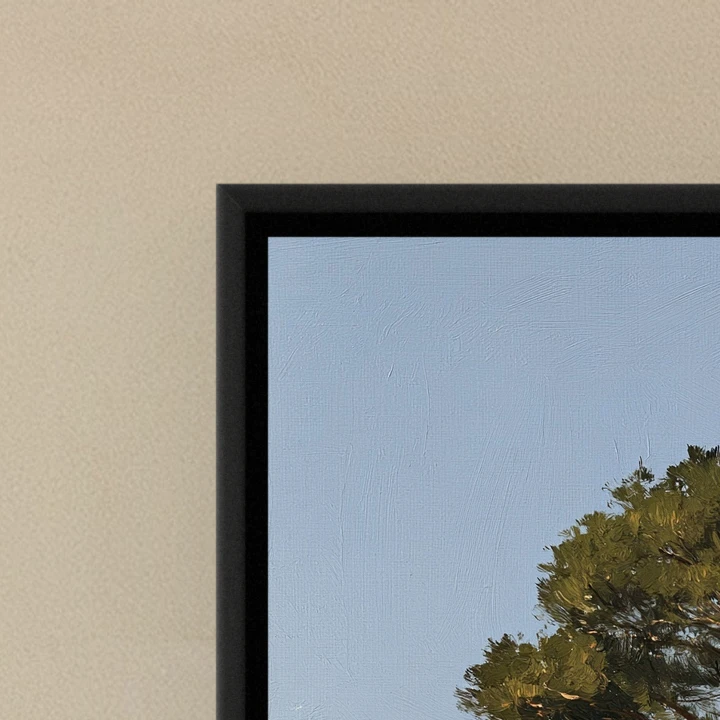
Seen from the side, a floater frame is L-shaped: a thin front face and a deeper side wall with a ledge inside it. The stretched canvas sits on that ledge and is fixed from behind, usually with screws or clips through the back. Because it is held from behind, the frame never touches the front of the canvas.
From the front you see three things: the whole canvas, a thin line of shadow all round it, and a narrow frame face. That shadow line is the gap, sometimes called the reveal or shadow gap. It is what makes the canvas look as if it hovers inside the frame.
The frame is usually a little deeper than the canvas. Prodigi's floater, for example, holds a 38 mm canvas and stands 53 mm off the wall (checked 2026-10-29). So from the side, the canvas edge is mostly hidden inside the frame.
Three different things called a floating frame
The name is used for three products, which is why buyers get confused:
- A canvas floater frame. The one this guide is about: an open frame around a stretched canvas, with a gap and no glass.
- A float-mounted print. A paper artwork raised on a backing board inside a deeper frame, behind glass, with its edges showing. Framers use it for prints with torn or deckled edges.
- A glass floating frame. Art pressed between two clear panes, so the wall shows through around it.
In a listing, write "floater frame for canvas" or "floating frame, no glass" so the buyer knows which one they are getting.
Floating frame vs standard frame
| Floating frame | Standard picture frame | |
|---|---|---|
| Holds | A stretched canvas | A paper print, photo or thin panel |
| Front of the art | Fully visible | Edges hidden under the frame's lip |
| Glass or acrylic | None | Usually |
| Mat | Never | Often |
| Between art and frame | A thin, dark gap | Nothing, or a mat |
| Look | Modern, gallery-like | Classic, crisp |
How much does a standard frame hide? Gelato gives an example: a 12 × 18 in poster in its frame has a visible area of 11 7/8 × 17 7/8 in, so about 1/16 in disappears on each side (Gelato Support, checked 2026-10-29). A floater hides nothing on the front.
Floating frame vs shadow box
A shadow box is a deep frame with glass in front and space inside, made to hold objects such as medals, shirts or keepsakes, or a print raised off the back. A floating frame has no glass: the canvas sits in its open front, nothing in the way.
The names overlap because a float-mounted print often goes in a shadow box. If your product is a canvas with no glass, call it a floating frame, not a shadow box.
Floating frame vs gallery wrap
A gallery wrap is a stretched canvas hung on its own, with no frame. Its sides are finished with part of the image, a mirror copy of the edge, or a plain colour. A floater frame is an extra frame around that same kind of canvas.
So it is not either-or: a framed canvas is usually a gallery-wrapped canvas inside a floater. Once it is framed, the sides are mostly hidden, so the edge style matters far less. For the edge choices, see canvas wrap edges. For which product to sell, see framed canvas vs stretched canvas.
Floating frame vs matted frame
A mat (also called a mount or passe-partout) is a card border around a paper print, under the glass of a standard frame. It gives the print space and keeps the glass off it. A floating frame never has a mat: the gap does the same visual job, with no glass to protect against.
If your product has a mat and glass, it is a framed print, and its photos should show the mat. Our guide to framed prints with or without a mat covers that choice.
When a floater frame is the right choice
From a seller's side, a floater is worth offering when:
- The art is a painting, abstract or photograph sold on canvas. The frame finishes it without hiding any of the picture.
- You want a premium option. A floater turns the same canvas into an upgrade you can show in every frame colour you sell.
- The buyer worries about edges. The frame protects the corners and hides the canvas sides, so the edge style matters less.
- The size is medium. Check the provider’s range: large framed canvases exist, but size, shipping and construction vary.
A canvas floater is not the usual choice for unsupported paper prints, which need suitable mounting and protection, and for very large or budget pieces, where a stretched canvas on its own is simpler.
Gaps and depths at print-on-demand providers
If you sell framed canvas through print on demand, check what your provider actually makes. Here is what three state on their own pages (checked 2026-10-29):
| Provider | What it says | Gap | Depth | Colours |
|---|---|---|---|---|
| Prodigi | Canvas floater frame | 5 mm | 53 mm from the wall | Black, white, antique gold, antique silver, natural, brown |
| Gelato | Wooden frame with a gap around the canvas | 12 mm | Frame 42 mm (North America), 32 mm (Europe) | Black, natural wood, dark brown |
| Printful | The frame gives the canvas a "floating effect" | Not stated | Frame 1.25 in (3.18 cm) thick | Black, brown, white |
Sources: Prodigi framed canvas, Gelato canvas and framed canvas, Printful framed canvas.
To show a floater convincingly, the photo needs the gap, the right frame colour and a believable shadow. The how-to, with gap widths in pixels, is in floating frame canvas mockups. WallMock draws the gap in black, white, natural oak, natural wood, walnut, espresso, gold and silver. Premium proportions is the default visual setting. Frame width and Floating gap adjust the visual proportions. Check exact gap, depth and finish against your provider’s specifications. It places your exact artwork in 500+ curated rooms.
Read next: floating frame mockup tips, floater mockups that match your POD supplier, framed or stretched canvas and canvas wrap edges.
Sources
- Prodigi: Framed canvas (floater frame, gap, depth, colours), checked 2026-10-29
- Gelato Support: Start selling canvas and framed canvas (gap, frame depth, colours), checked 2026-10-29
- Gelato Support: Frame sizes (visible area of a framed poster), checked 2026-10-29
- Printful: Framed canvas (floating effect, frame thickness, colours), checked 2026-10-29