Listing photo guide · 5 min read
How to write alt text for wall art photos
Short answer: Describe the information a buyer would miss without seeing the image: the artwork, the product or finish, and the view shown. Keep it concise and specific to that photo. Do not turn alt text into a keyword list or repeat the listing title. Etsy recommends up to 250 characters; Shopify recommends 125 or fewer (maximum 512), so write for the image first and check each platform’s current limit.
Alt text is a text alternative for someone who cannot see a photo. For a wall-art listing, it should help them understand what that particular image adds. First plan the image sequence with our guide to Etsy listing photos, then describe each image on its own.
A simple formula
Start with the subject, then add the product and view only when they matter:
[Artwork or subject] + [product/finish] + [what this photo shows]
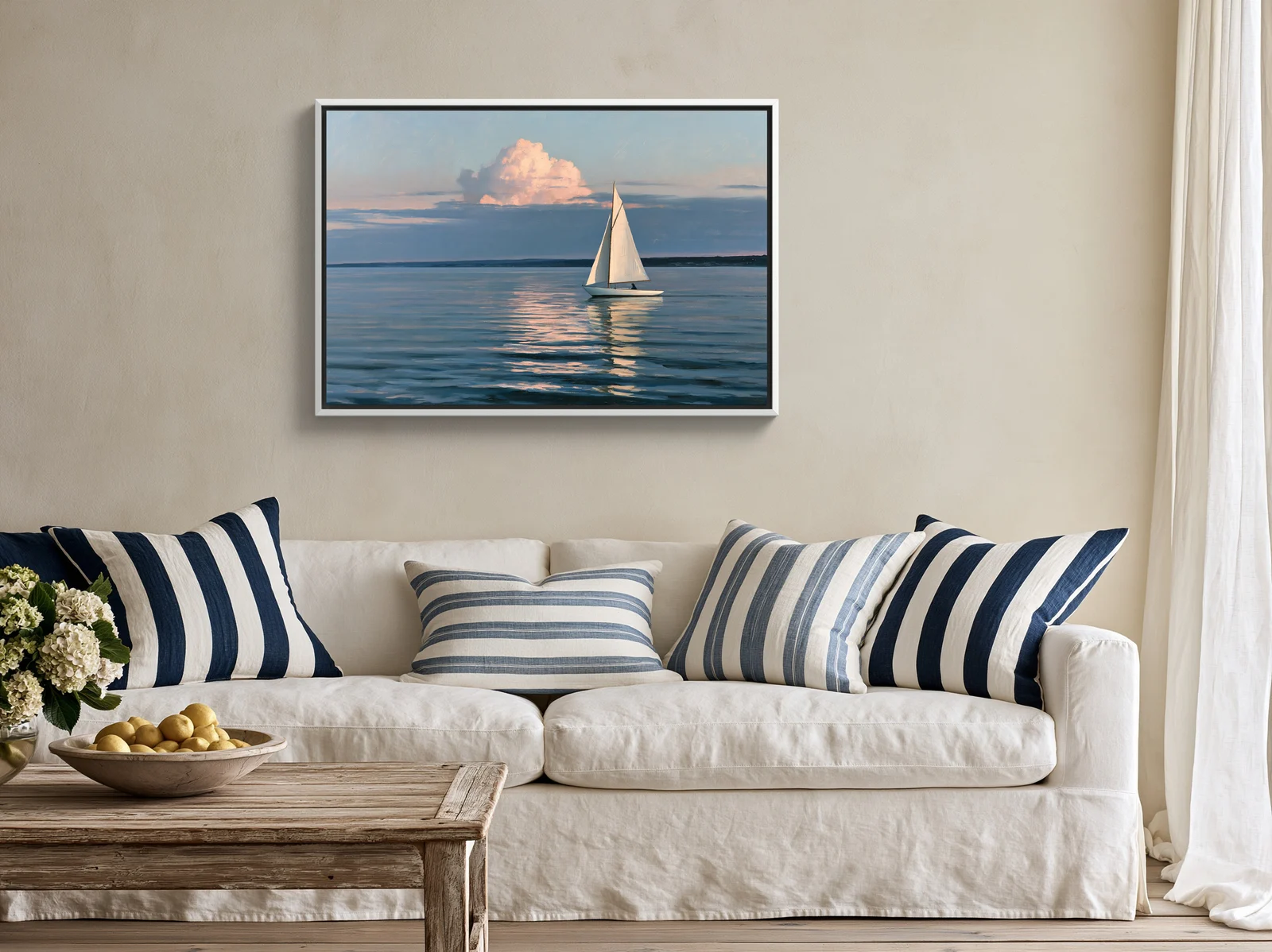
For example: “Sailboat at dusk on a white floating-frame canvas, shown above a white sofa with navy cushions.” That says what is pictured without stuffing in “wall art,” “home decor,” and every room keyword.
Describe what can actually be seen. If the image is a close-up of the frame corner, say so. If it shows a room-scale view, name the furniture that helps orient the print. Avoid claims the picture cannot establish, such as exact dimensions, paper quality, or how a color looks in person.
Write different text for different photos
| Photo | Useful alt text | What it tells the buyer |
|---|---|---|
| Hero room | “Sailboat at dusk on a white floating-frame canvas above a white sofa with navy cushions.” | Artwork, finish, and room view. |
| Artwork by itself | “Sailboat on calm water beneath a peach evening sky, with a dark shoreline across the horizon.” | The composition without the room. |
| Frame detail | “Close view of the white floating frame, showing the narrow gap around the canvas.” | The construction detail visible in this image. |
| Size chart | “Canvas sizes shown beside a sofa: 16 × 20, 24 × 36, and 30 × 40 inches.” | The chart’s actual choices; put all essential dimensions in listing text too. |
If two photos show the same art in different rooms, describe the room in each one. Do not paste the same sentence into every image field. For choosing which room views and product details to include, see the listing-photo sequence guide; for the wording around titles and listing fields, see Etsy SEO for wall art.
Skip these common mistakes
- Keyword strings: “wall art, canvas art, framed art, living room decor, gift” does not describe the photo naturally.
- Unseen claims: don’t infer exact scale, material, archival quality, or color accuracy from a mockup.
- Redundancy: don’t repeat the whole title, shop name, price, or tags. Etsy says these add no extra SEO benefit in alt text.
- “Image of” by habit: start with the useful description unless context makes the image’s role unclear.
- One description everywhere: alt text belongs to the image and page context. Update it when the photo changes.
Etsy and Shopify have different limits
Etsy’s help says descriptions should be concise and up to 250 characters. It encourages describing item details, texture, and scale relative to objects in the photo. It also says alt text serves people who cannot see the image; repeating shop names, titles, tags, or other listing text provides no additional SEO benefit (Etsy Help, checked 2026-10-31).
Shopify recommends brief, descriptive alt text of 125 characters or fewer, with a maximum of 512 (Shopify Help, checked 2026-10-31). These are platform-specific limits. Use the shorter applicable recommendation where practical, and check the field you are editing because platform guidance can change.
Neither platform’s guidance is a promise of higher placement. The main job is to give a useful text alternative.
When to leave alt text empty or describe the function
For a meaningful listing photo, describe the information the photo contributes. W3C’s guidance says context matters: decorative images that add no information may use empty alt text; an image that acts as a link should convey the link’s purpose; complex charts need the important information available in text as well (W3C image decision tree, checked 2026-10-31).
On a marketplace listing, use the platform’s image-description field for the product photo. On your own store, follow the theme or content system’s rules for decorative and functional images. Do not use an empty description for a meaningful product view simply to avoid writing one.
Finally, make the picture itself accurate. Etsy’s image policy requires listing images to represent what buyers will receive, with specific rules and exceptions for some products. A careful alt description cannot fix a misleading photo (Etsy listing image requirements).
WallMock places your file as supplied; the room is a presentation, not a physical sample or a measurement of print size. Keep material, size, and finish claims tied to the supplier product you actually sell.
On paid plans, the listing kit from the Etsy mockup generator includes alt text for every photo; read it against each photo and edit it to say what that photo actually shows.
Read next: plan the photos in your listing, Etsy SEO for wall art and check the physical sample.
Sources
- Etsy Help: Add text alternatives to listing images, checked 2026-10-31
- Shopify Help: Add alt text to media, checked 2026-10-31
- W3C WAI: Image decision tree, checked 2026-10-31
- Etsy: Listing image requirements, checked 2026-10-31