Canvas guide · 5 min read
Canvas depth 0.75 vs 1.5 inch: which to sell, and how to show it
Short answer: Sell 1.5 in (38 mm) gallery canvas for large pieces that hang without a frame, and 0.75 in (19 mm) thin canvas for small and medium pieces, shelves and anything going into a frame. Then use your provider's real number, not the label: Printful's standard canvas is 1.25 in, Gelato makes 2 cm and 4 cm, Prodigi 19 mm and 38 mm (checked 2026-10-29). Put that exact depth in the listing and prove it with a side close-up of a sample.
A front-on photo hides depth completely, which is why it's so easy to get wrong. Check the number first, then pair it with your canvas print mockups.

Common canvas depths, in inches and millimetres
| Depth | In mm | Usually called | Provider examples (checked 2026-10-29) |
|---|---|---|---|
| 0.75 in | 19 mm | Thin or slim canvas | Printful Thin Canvas, 0.75 in (19.05 mm). Prodigi slim canvas, 19 mm. Gelato slim, 2 cm (0.8 in) |
| 1.25 in | 32 mm | Standard canvas at some providers | Printful Canvas, 1.25 in (3.18 cm) |
| 1.5 in | 38 mm | Gallery, deep or thick canvas | Prodigi stretched canvas, 38 mm. Gelato thick, 4 cm (1.6 in) |
Sources: Printful thin canvas and canvas; Prodigi slim canvas and stretched canvas; Gelato canvas.
Don't trust the word "standard". Printful's regular canvas is 1.25 in, not 1.5 in. Call it a "1.5 in gallery wrap" and your listing is wrong by a quarter of an inch, on the one detail a buyer can check with a ruler.
Thin or deep: which to sell
Thin canvas (0.75 in) is lighter and sits flatter against the wall. Use it for small and medium sizes, shelves and leaning displays, and for anything that goes into a frame: Gelato's framed canvas uses a slim 2–3 cm canvas (checked 2026-10-29).
Deep canvas (1.5 in) stands off the wall like a block, and that's the point of it on a large unframed piece. The deeper side also shows more canvas edge for the same front size, so the edge style matters more. Our guide to canvas wrap edges covers mirror, image and white or black sides.
Size often makes the decision for you. Printful's thin canvas comes in 13 sizes from 8×10 to 24×36 in, while its 1.25 in canvas goes up to 40×60 in. Go bigger than 24×36 in unframed at Printful and you're selling the 1.25 in canvas, whether you planned to or not.
Offer both depths only if you'll show both. Each depth is another variation, and each needs its own side photo.
Depth changes your file
With image wrap, the picture covers the sides, so a deeper canvas needs more picture. Add the depth to every side:
- A 24 × 36 in canvas, 0.75 in deep, needs 25.5 × 37.5 in of picture: 3825 × 5625 px at 150 DPI.
- The same canvas, 1.5 in deep, needs 27 × 39 in: 4050 × 5850 px at 150 DPI.
Those figures cover front and sides only, before any fold or bleed the supplier adds, so upload to the supplier's own template rather than these numbers. Mirror wrap and plain sides keep the whole front composition, but still follow that template. The full table by size is in what DPI a canvas print needs, and the print resolution checker reads your own file.
How depth shows in a photo
Front-on, there's one clue: the shadow. A deeper canvas stands further from the wall, so under the same light it casts a slightly wider, softer shadow on the side away from the light. A canvas with no shadow at all looks like a poster stuck flat to the wall.
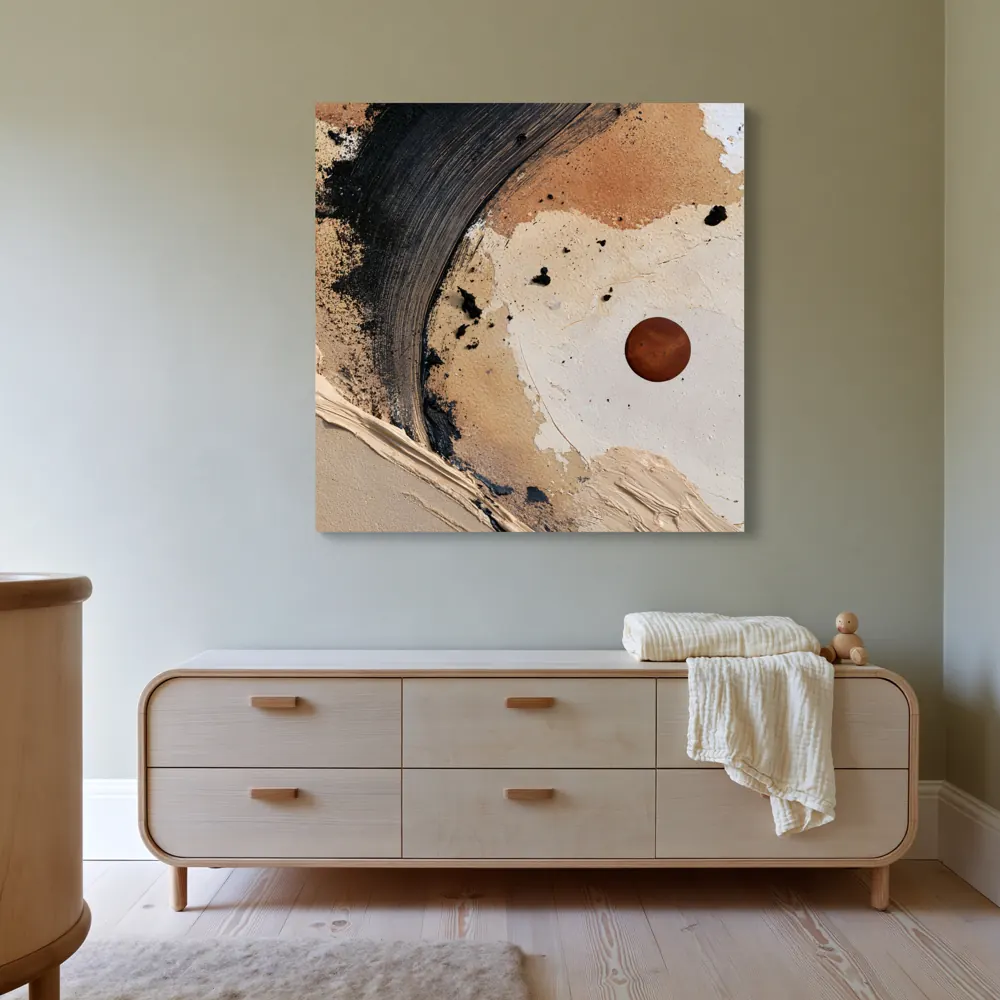
That's also the limit of a room mockup. WallMock's stretched canvas renders are front-on: they show the wall shadow, not the wrapped side or its edge colour. The depth itself has to come from a photo of your sample:
- A close-up at an angle, showing one side and a corner.
- The side next to something everyone knows the size of, such as a hand or a pencil.
- A simple diagram with the depth marked in inches and millimetres.
Put the side close-up early
On a canvas listing, the close-ups are where you prove construction, and for stretched canvas that means the side. Don't bury it at slot 15. My listings give the second slot, straight after the hero room, to a close-up card. If the product is new to you, order the sample before you write the depth into a listing.
Framed canvas depth
On a framed canvas, the buyer sees the frame from the side, not the canvas. Providers state it differently (checked 2026-10-29):
- Prodigi: a 38 mm canvas in a floater that stands 53 mm off the wall (source).
- Gelato: a frame 42 mm deep in North America and 32 mm in Europe, around a slim canvas (source).
- Printful: a pine frame 1.25 in (3.18 cm) thick (source).
A floater is built around one canvas depth, so a deep 1.5 in canvas needs a frame made for it, as Prodigi's 53 mm floater is for its 38 mm canvas. If you sell a framed upgrade, check the provider frames the same depth you sell unframed. Give the frame depth for the region you ship from and show it in a corner close-up; the floating frame mockup guide explains how frame depth reads in a room photo.
Common depth mistakes
- Rounding up. Calling a 1.25 in canvas "1.5 in gallery wrap" because it sounds better.
- Mixing up canvas and frame depth. For framed canvas, give the frame's number.
- One number for every region. Gelato's frame changes between North America and Europe.
- Forgetting the wrap. Moving to a deeper canvas with image wrap without adding picture to the file eats more of the front.
- Showing the wrong sample. A close-up of a deep canvas on a thin canvas listing.
How to state depth in a listing
- Put it in the first lines: "Canvas depth: 1.5 in (38 mm). Image wraps around the sides."
- Name variations by depth if you sell both: "Thin canvas, 0.75 in" and "Gallery canvas, 1.5 in".
- Use your provider's number, not a rounded one.
- Show the side of the depth you sell, never a deeper sample than the product.
Etsy's image rules say all images must accurately reflect the item's true appearance, including colour, scale and materials (Etsy Help, checked 2026-10-29). Depth is part of that.
WallMock makes the room photos, your exact artwork as stretched or framed canvas across a whole collection at once; your sample close-up supplies the side view.
Read next: canvas wrap edges, canvas print DPI and framed or stretched canvas.
Sources
- Printful: Canvas prints (Canvas 1.25 in), checked 2026-10-29
- Printful: Thin canvas (0.75 in), checked 2026-10-29
- Printful: Framed canvas (frame 1.25 in), checked 2026-10-29
- Gelato Support: Start selling canvas and framed canvas (2 cm and 4 cm; frame depth), checked 2026-10-29
- Gelato Support: FAQs framed canvas (slim 2–3 cm canvas), checked 2026-10-29
- Prodigi: Stretched canvas (38 mm), checked 2026-10-29
- Prodigi: Slim canvas (19 mm), checked 2026-10-29
- Prodigi: Framed canvas (53 mm from the wall), checked 2026-10-29
- Etsy Help: Requirements and best practices for images, checked 2026-10-29