Canvas guide · 5 min read
Large and oversized canvas mockups (40×60, 48×72): showing scale honestly
Short answer: Oversized canvas is where room photos most often mislead, so pair every room mockup with plain numbers. State the canvas size and the outside size in inches and centimetres, add a size guide image drawn from real measurements, and check that the piece fits. A 40×60 in landscape suits an 80–90 in sofa. A 48×72 in portrait is 6 ft tall and won't fit above a sofa under an 8 ft ceiling. Use room photos for style, not as proof of size.
Big canvas sells on drama, and comes back when it isn't the size the buyer pictured. Here is how to show size honestly alongside your canvas print mockups.
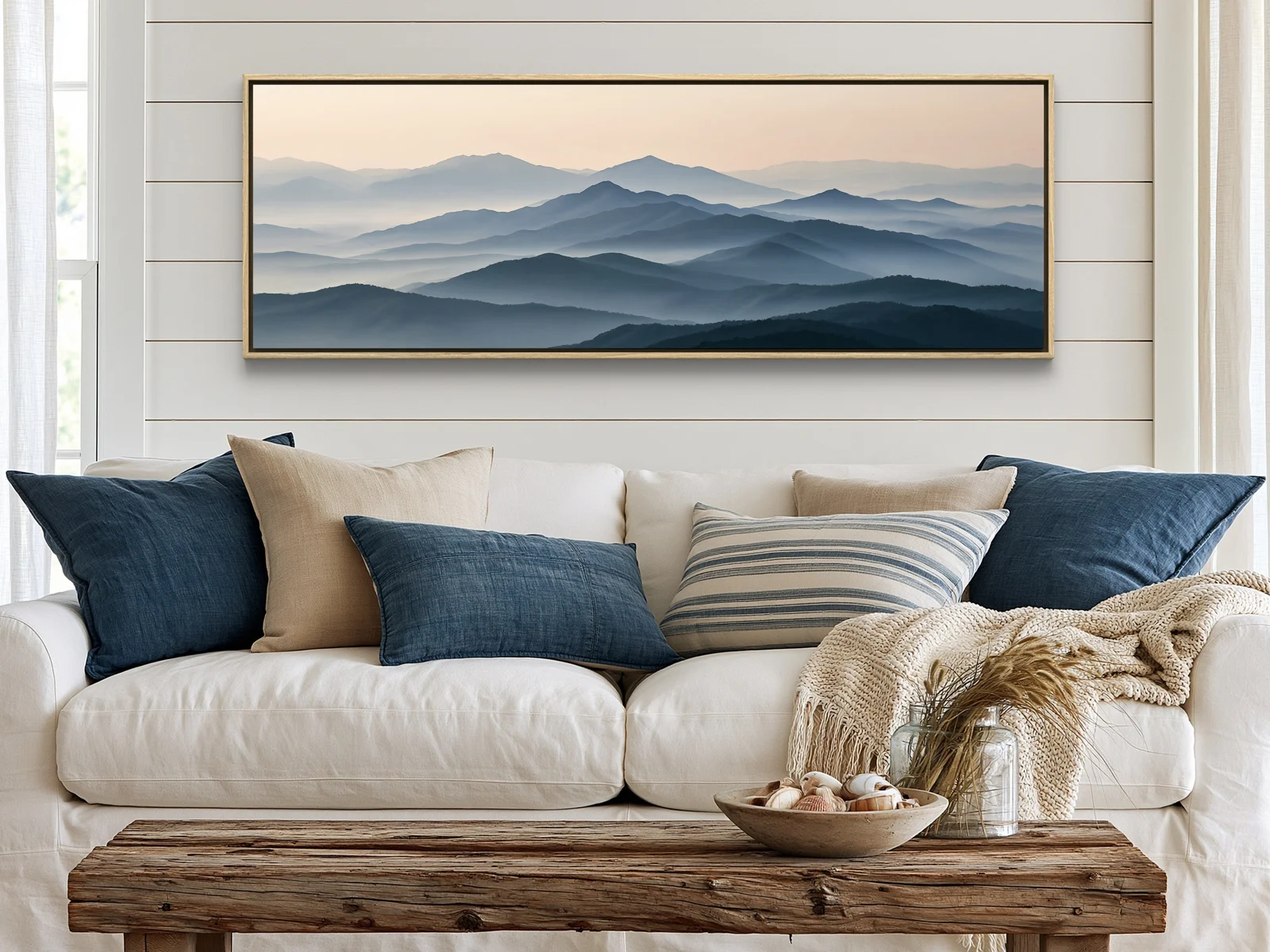
An outer-frame check before calling a size a fit
Suppose your supplier specifies a 24 × 36 in canvas, a 5 mm gap and a 12 mm frame face. Each outside dimension gains twice (5 + 12) mm, or about 1.34 in: roughly 25.34 × 37.34 in overall. This is a geometry example, not a measurement of every supplier product. Use the published outer dimensions when available, and measure the buyer’s actual clear wall before promising a fit.
A size-guide rectangle can show that numeric comparison. A staged room can show style. The testing page keeps those evidence claims separate.
Why big canvases need extra honesty
A buyer can't hold a 48×72 in canvas up to the wall before ordering. They judge size from your photos, then measure their wall. If the two disagree, a buyer may complain or request a return, and an oversized parcel is costly to ship back.
Etsy's image rules say all images must accurately reflect the item's true appearance, including colour, condition, scale and materials (Etsy Help, checked 2026-10-29). Scale is in that list. A room photo that makes a 24×36 in canvas look like a wall-filling statement piece breaks it.
Will it fit? Width, height and ceiling
A common interior guideline is that art over furniture looks balanced at two-thirds to three-quarters of the furniture's width. Height matters just as much for big pieces. This table assumes a sofa back about 32 in (81 cm) high and the bottom of the canvas 8 in above it, so the bottom edge is at 40 in:
| Canvas | Width on the wall | Suits furniture about | Top edge over a sofa | Fits under |
|---|---|---|---|---|
| 30×40 in landscape | 40 in | 53–60 in | 70 in | Above 70 in plus clearance, under these assumptions |
| 40×60 in landscape | 60 in | 80–90 in | 80 in | An 8 ft (96 in) ceiling |
| 48×72 in landscape | 72 in | 96–108 in | 88 in | 8 ft, with 8 in to spare |
| 40×60 in portrait | 40 in | 53–60 in | 100 in | A 9 ft (108 in) ceiling |
| 48×72 in portrait | 48 in | 64–72 in | 112 in | A 10 ft (120 in) ceiling |
The lesson: big portraits rarely belong over a sofa. They suit tall open walls, stairwells, entrances and rooms with high ceilings. On an open wall with the centre at 57 in, a 48×72 in portrait runs from 21 to 93 in, just 3 in under an 8 ft ceiling. The art size over a sofa calculator works out the width for any furniture, and the hanging height guide covers the gaps above sofas, beds and sideboards.
Make a size guide image from real measurements
A size guide is the most honest photo in a large-canvas listing, because it is built from numbers, not from a staged room. Make one in any drawing app:
- Pick one scale and keep it, for example 5 px per inch.
- Draw a reference everyone knows at that scale: an 84 in sofa is 420 px wide; a person 5 ft 6 in tall is 330 px.
- Draw each size you sell as a rectangle at the same scale: 30×40 in is 150 × 200 px, 40×60 in is 200 × 300 px, 48×72 in is 240 × 360 px.
- Label each one in inches and centimetres, with the outside size if it is framed.
- Write "drawn to scale" only if it is.
The print size calculator lists every standard size in your artwork's ratio, to identify matching ratios. Check pixels with the resolution checker and confirm that your supplier offers the product size.
Use room photos for style, not as a ruler
Room mockups are the best way to show how a large canvas changes a room: the mood, the colours, the furniture it suits. They are not measuring tools. WallMock's rooms are curated, digitally staged interiors, and each one shows your artwork at a size reviewed to suit that room. Default placement is not proof of a particular physical size. You can enter a 4–60 in long-side size and use estimated wall scale in 332 rooms; the range is estimated from the photo, not measured on a wall. A 48 × 72 in canvas exceeds that 60 in entry limit, even though its ratio can be shown at a reviewed placement. Add exact labelled dimensions for the product.
- Choose rooms where a big piece is believable: long sofas, wide beds, large walls. A huge canvas over a small console looks wrong at any real size.
- Keep the artwork's true ratio. Never stretch a 2:3 file wider to make it feel bigger.
- Say it in the description: "Room photos show the style. See the size guide for exact dimensions."
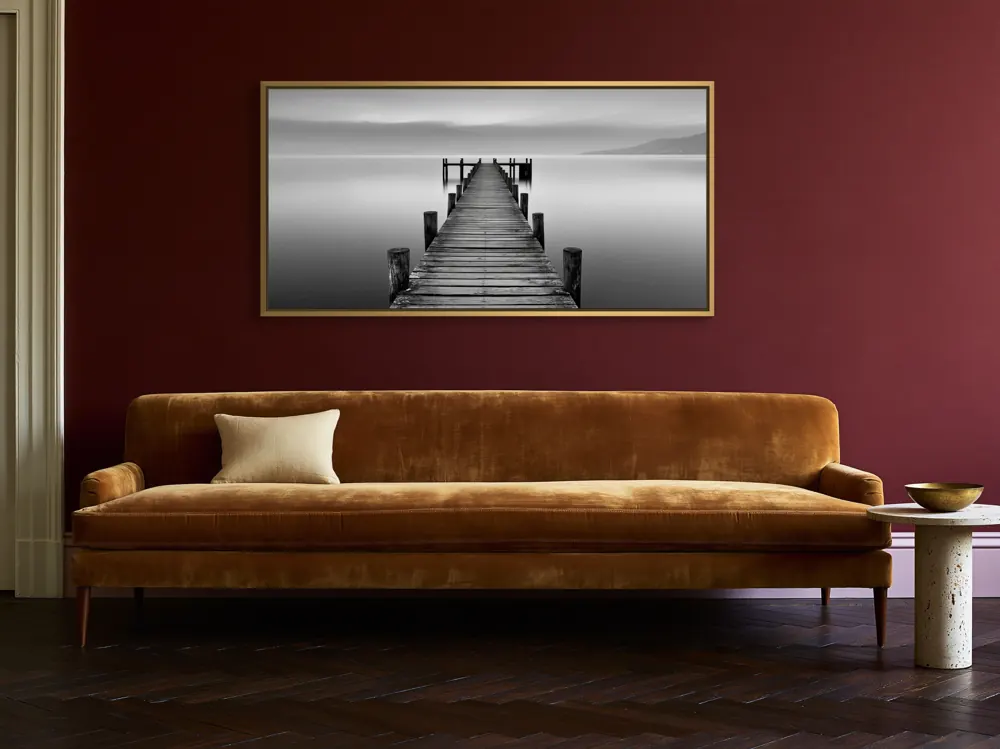
Show one sample at full size
If you sell 40×60 in and up, order the largest size once before listing it. Photograph it on a wall with something familiar beside it: a door, a chair, a person standing a step to the side. One honest photo of the real object does more for trust than ten room mockups, and it also shows you how the print looks at that size.
Sizes and files for big canvases
Not every provider makes oversized canvas, and framed options stop sooner. From each provider's own page (checked 2026-10-29):
- Printful lists stretched canvas up to 40×60 in, and framed canvas up to 24×36 in (canvas, framed canvas). 48×72 in is not on its list.
- Gelato lists framed canvas up to 60×90 cm, or 24×36 in (source).
- Prodigi lists framed canvas from 4×6 to 55×55 in (source).
- Printify lists gallery frames up to 32×48 in vertical and 60×20 in horizontal (source).
The file has to keep up. A 40×60 in canvas needs 6,000 × 9,000 px even at 150 DPI, and 48×72 in needs 7,200 × 10,800 px. The canvas print DPI guide has the full table, including the extra for wrapped edges.
Words to put in the listing
- "Canvas: 48 × 72 in (122 × 183 cm). Depth 1.5 in (38 mm)."
- "With frame: [outside size from your provider]."
- "Best on walls at least [width] wide; too tall to hang over most sofas under an 8 ft ceiling."
- "Room photos show the style. Photo [number] shows the exact size."
Then make the room photos for every artwork at once, as stretched or framed canvas in 500+ curated rooms. Try WallMock free with no sign-up and no card: up to three artworks in 8 sample rooms, as watermarked previews made on your device.
Read next: the art size over a sofa calculator, canvas print DPI and canvas print sizes.
Sources
- Etsy Help: Requirements and best practices for images (scale), checked 2026-10-29
- Printful: Canvas prints (sizes to 40×60 in), checked 2026-10-29
- Printful: Framed canvas (sizes to 24×36 in), checked 2026-10-29
- Gelato Support: FAQs framed canvas (sizes), checked 2026-10-29
- Prodigi: Framed canvas (size range), checked 2026-10-29
- Printify: Custom framed canvas (gallery frame sizes), checked 2026-10-29