Why sell sets
A matching pair or trio raises the order value and solves a real problem for buyers: filling a large wall above a sofa or bed with pieces that clearly belong together. Many buyers search specifically for a 'set of 2' or 'set of 3', and sets are one of the easiest ways to stand out from single-print listings.
Sets also suit the way artists work: a series of botanicals, three views of the same coast, or one panorama split across three canvases.
Use consistent gaps
Keep the space between pieces equal. In real homes, gaps of about 3–6 inches (8–15 cm) between frames are a common guideline; wider gaps make pieces feel unrelated, narrower ones look cramped. The gap should be the same between every piece in the group.
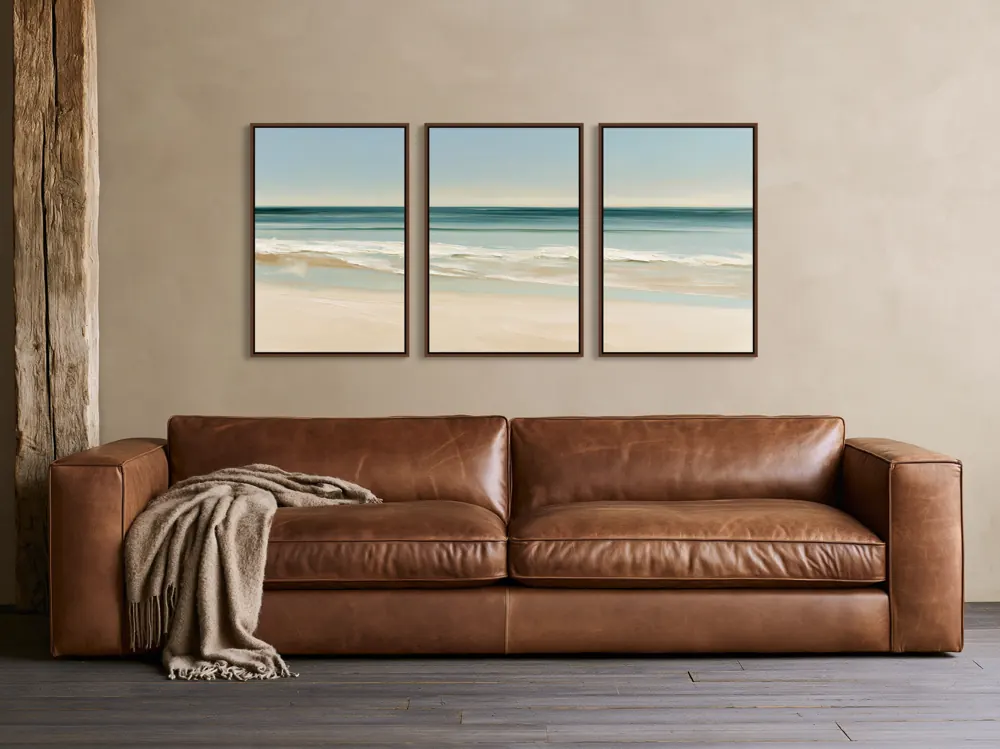
Align on a shared centre line
For a row of equal pieces, align tops and bottoms. For mixed sizes, align the centres horizontally. Centre the whole group on the furniture below, not each piece separately.
For a 2×2 grid, keep the vertical gap the same as the horizontal gap so the grid reads as one square block.
Which layout for which wall
| Layout | Best wall | Group width rule |
|---|---|---|
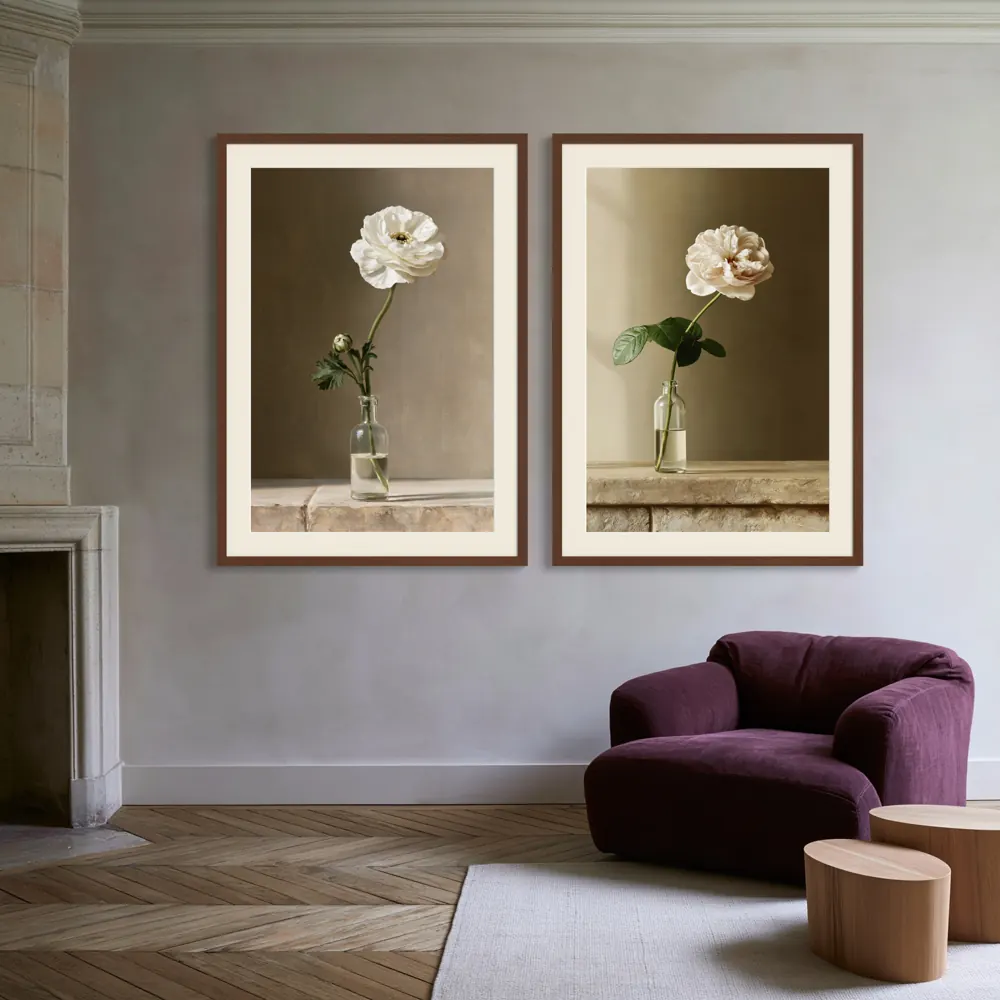
| Pair, side by side | Above a bed, a narrow sofa or a console | About two thirds of the furniture width |
| Pair, stacked | A narrow pier or beside a doorway | Fits the narrow wall with a margin each side |
| Trio in a row | Above a sofa, bed or long sideboard | About two thirds to three quarters of the furniture |
| Set of four, 2×2 grid | A square wall area, a dining room or a stair landing | Even gaps both ways; a square block |
| Set of four in a row | Very long furniture or a hallway | Keep pieces small enough for the gaps to read |
Choose rooms with enough wall
A pair needs a wide wall; a trio needs more. Above a sofa, a bed or a long sideboard is the classic place. Our gallery wall spacing calculator works out the group width, the gaps and where each piece goes for a pair, trio, row of four or 2×2 grid.
Make the series obvious
Use matching frames and mats, and order the pieces so colours or subjects lead the eye across the group. Then show each piece on its own too, so buyers can see the details.
In the listing, say exactly what is included (for example 'set of 3 prints, 30×40 cm each, frames not included'), because sets are where buyers most often misread the quantity.
Sets in WallMock
WallMock can place one pair, trio or set of four together in rooms that support it, with even gaps, and lets you adjust the gap and group placement where the room allows it. To make those listing photos for a whole collection, use the gallery wall mockup generator.
Open the gallery wall spacing calculator →
Questions sellers ask
How far apart should a set of three frames be?
About 3–6 inches (8–15 cm) between frames is a common guideline for most sizes. Keep every gap the same.
How wide should a trio be above a sofa?
About two thirds to three quarters of the sofa's width for the whole group, centred on the sofa.
Should a set of 3 be one image split into three?
It can be. A split panorama reads as one artwork; three related pieces read as a series. Both sell; say clearly which one the buyer receives.